

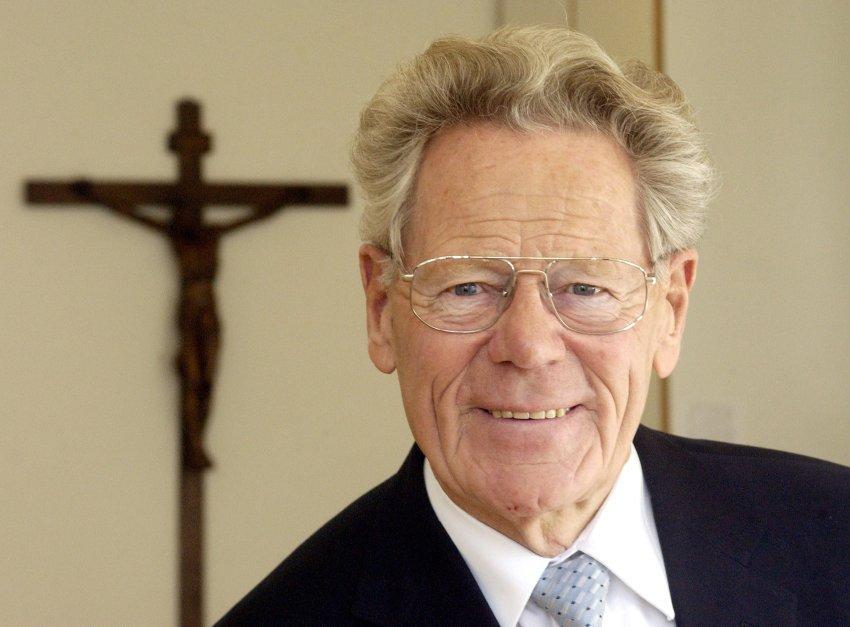
Theologian, engaged intellectual, proponent of interfaith
dialogue, friend. Born on March 19, 1928, in Sursee,
Canton of Lucerne, Switzerland; died on April 6, 2021, in
Tübingen, Germany, aged 93.
The strength of the InterAction Council is the interplay
between men and women who know the ways of power and world
class intellectual experts who bring their insights and
frameworks into the world of policy analysis. Hans Küng
was the exemplar of the ideal of such an engaged public
intellectual. Parish priest, professor, author of over 50
books, advisor to presidents, lover of Mozart, Küng is
perhaps best remembered as an advocate of reform in the
Roman Catholic Church. His disputes with the Vatican
hierarchy were certainly long lasting and took an
emotional toll on him personally, but he never backed away
from his beliefs. Born into a large Swiss family, the
eldest of five sisters and a brother, Hans decided to
become a priest early on, leaving his girlfriend, he
writes in his memoirs, after only one kiss.
He was ordained as a priest in 1954, saying his first mass
in St Peter’s Basilica to the Sunday service of the Swiss
Guards, many of whom were from his home canton of Lucerne.
Speaking six languages, and a brilliant student of
philosophy, Küng received his doctorate in 1957 and, after
initially serving as a local priest, he decided on the
academic life, joining the faculty of theology in Tübingen
University in 1960. Despite later controversies with the
Vatican, Hans never left the priesthood though he
developed a distinctive style of his own, favouring well
cut suits rather than the vestments, driving a sports car
and enjoying a glass of wine at the receptions of the
Council.
The 1960s were a heady age of reform and Pope John
the XXIII appointed Küng as the youngest expert
advisor to the Second Vatican Council where he
enthusiastically joined debates within the Roman Catholic
church, advocating, for example, that contraception should
be a personal choice. In 1963, US President John F.
Kennedy invited Hans to the White House with the
introduction: “this is what I would call a new frontier
man of the Catholic church.” In 1971, however, Küng
questioned the notion of papal infallibility and the
Vatican revoked his position as an official Catholic
theologian.
These theological disputes gave Küng prominence, but I saw
a very different side of his personality. I met him in
1996 when Helmut Schmidt, the former Chancellor of
Germany, organized a series of interfaith dialogues for
the InterAction Council around the theme of “No Peace
Among Nations Until Peace Among Religions,” a famous
public lecture by Küng. Years before 9/11 and the Clash of
Civilizations thesis so prominent in the decades after
that tragic event, guided by the insights of Küng, the
InterAction Council took up the task of examining and
promoting the notion that what unites us ethically from
different faith traditions is far more important than what
divides us. The result was the Council’s “A Universal
Declaration of Human Responsibilities,” now translated
into 40 languages and designed to be a companion piece to
the UN’s Universal Declaration of Human Rights.
Curious, learned, sensitive and rigorous,
Küng was the perfect interlocutor between the
representatives of the various faiths; he was delighted to
cite, for example, that the Golden Rule of the New
Testament “So in everything, do to others what you would
have them do to you” was in every faith tradition and
would quote effortlessly Confucius, Hillel, Buddha, the
Koran and others, making the explicit point that ethics is
part of the natural order in all parts of the world.
In recent years illness prevented Hans from travelling but
he still was alive with ideas and was often in contact
about the agenda of the Council. The media may have
portrayed Hans as a Catholic “rebel” but Council members,
during his active years, knew him as a “connector”
bringing together different traditions and finding common
ground. Former US President Jimmy Carter once attended a
plenary meeting of the Council for the explicit reason
that he learned that a paper by Hans was on the agenda.
Hans Küng believed in the moral force of example and his
own life is an example of how public intellectuals can use
their gifts to enlighten, engage and bring about
understanding. The InterAction Council cherishes his
contributions and grieves that he is no longer with us.
Thomas S Axworthy is Secretary General of the
InterAction Council.