


By Mike Hightower, Distinguished Member of the
Technical Staff, Sandia National Laboratories
Water is an integral part of energy development,
production, and generation. Water is used directly in
hydroelectric power generation and is used extensively for
thermoelectric power plant cooling and air emissions
control. Water is also used extensively in
energy-resource extraction, refining, and processing, as
well as for energy resource
transportation. Therefore, as global energy
consumption continues to increase, as much as 50% by 2030,
so will the demand for water supplies and resources to
support this growth. This will place the energy
sector into greater competition with other water users for
already limited fresh water resources in many regions of
the world. This competition for water resources will
likely impact regional energy reliability and energy
security.
While the issues of the interdependencies between energy
and water were highlighted in initial studies in the
United States (DOE, 2007), concerns over energy and water
security and reliability are being recognized worldwide by
energy officials, energy and water managers, and the
scientific community. For example, the World Economic
Forum published a report in early 2009 discussing concerns
about water demands for energy and potential global
impacts that could occur on energy availability,
reliability, and security (WEF, 2009). Likewise, the
World Energy Council in September 2010 published a report
on “Water for Energy”, highlighting that “In recent
decades, the combination of more users, with more uses of
water has transformed the traditional water-energy ladder
that underpins all human, social, and economic development
into an escalator” (WEC, 2010). As nations try and
balance the demands and availability of water resources to
support human health and economic development in the
coming decades, it is clear that the water footprint, like
the carbon footprint, will become an increasingly critical
factor to consider for secure, reliable, and sustainable
energy development worldwide.
Reducing the Energy Sector Water Footprint
The projected water demands for electric power generation,
carbon sequestration or reduction requirements,
alternative transportation fuels to reduce imports – such
as biofuels, oil shale, oil sands, coal-to-liquids,
hydrogen, and development of natural gas supplies from gas
shales, will intensify competition for already limited
fresh water resources in many regions. Many of the
efforts noted are to ostensibly reduce energy imports by
using domestic energy supplies to increase energy
security, but in reality they could negatively impact both
energy and water security. Therefore, approaches are
needed that can increase freshwater use efficiency and
reduce the freshwater footprint of current and emerging
energy options. Water-related energy concerns can be
addressed in a number of ways including; developing
additional surface water storage infrastructure and ground
water supplies, transferring water from the agricultural
sector or from different regions, improving water
conservation and water use and reuse efficiency, improving
and integrating water and energy planning, or using
non-traditional water resources – such as saline and waste
water - to offset fresh water use.
To provide a the general overview of the relative scale of
the emerging energy and water interdependencies and
security issues, recent efforts in the United States to
assess and address potential energy and water conflicts
are highlighted. In 2005, the U.S. Congress funded
the Department of Energy to first, prepare an Energy-Water
Report to Congress to identify and quantify emerging
energy and water challenges and interdependencies, and
second, to conduct a series of regional workshops to
identify the science and technology needed to address and
reduce the identified emerging energy and water
challenges. Both efforts were coordinated by Sandia
National Laboratories with the support of all the U.S.
national laboratories. The information collected for
both efforts is available on the Sandia web site
at www.sandia.gov/energy-water.
As identified in the U.S. Energy-Water Report to Congress,
over 50 percent of current daily water withdrawals in the
U.S. and about 25 percent of all current daily
non-agricultural fresh water consumption are for
energy-related uses. As the population and economy of
the U.S. grow, the demand for both energy and water are
also expected to grow. While the water needs to meet
the growth for electric power generation and
transportation fuels production will depend on the type
and number of power plants built, cooling technologies
used, air and carbon emission requirements, and the type
and quantity of alternative fuels used, estimates
suggested that water consumption by the energy sector
could grow by a factor of three to four by 2035,
increasing from about 4.3 billion gallons of water per day
(BGD)(17 billion liters per day) in 1995, to about 12-15
BGD (47-60 billion liters per day) by 2035. This
would make the energy sector the largest non-agricultural
water consumption sector in the U.S.
The projected growth in water demand for energy generation
and development over the next two decades will occur at a
time when the nation’s fresh water supplies are becoming
increasingly stressed. These water issues were
summarized in a U.S. General Accountability Office (GAO,
2003) report on water availability:
“National water availability and use has not been
comprehensively assessed in 25 years, but current trends
indicate that demands on the nation’s supplies are
growing. In particular, the nation’s capacity for storing
surface-water is limited and groundwater is being
depleted. At the same time, growing population and
pressures to keep water in stream for fisheries and the
environment places new demands on the freshwater supply.
The potential effects of climate change also create
uncertainty about future water availability and use.”
Figure 1 summarizes the results of a survey of state water
managers in the U.S. from the GAO report showing a
general, nation-wide, concern about future water shortages
in the next decade under average water supply
conditions. Droughts in several regions across the
U.S. from 2005 through 2008 drew even more attention to
regional water issues. The data in Figure 1 highlight
the growing concerns over fresh water supplies in the
U.S., and suggest that water problems are no longer just a
western U.S. concern, they have become a national
issue. The data suggest that competition for
increasingly limited water resources in many parts of the
U.S. will likely impact projected regional energy
development and therefore associated energy supply
reliability and security.
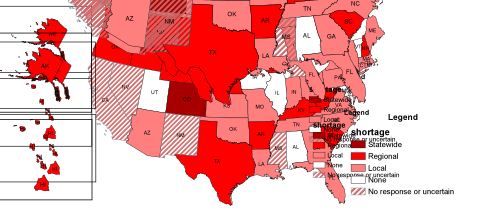
Figure 1. Expected State Water Shortages by 2013 for
Average Conditions (GAO, 2003)
While the U.S. Energy-Water Report to Congress focused on
identifying emerging U.S. energy and water
interdependencies challenges and concerns, the regional
workshops were organized to look at energy and water needs
from a broad spectrum of disciplines, and identify
research efforts needed to minimize future conflicts
between energy and water development and foster more
reliable and sustainable use of these two very important
natural resources. More than 500 participants
representing federal, state, local and tribal water and/or
energy agencies, water and energy managers, water and
energy utilities and industrial associations,
environmental groups, technology developers, and academia
from across the U.S. participated in the Energy-Water
workshops that took place from November 2005 through May
2006. Based on these workshops, three major
directions to address the emerging energy and water
interdependencies challenges were identified. A short
overview and summary of the energy research needs and
directions suggested were published by Sandia (Pate et al,
2007). The three major science and technology
research and developments directions identified from the
workshops are summarized included:
Reduce fresh water use in electric power and
transportation fuels development. Several renewable energy
technologies and alternative cooling approaches for
thermoelectric power plants exist that could reduce water
consumption for electric power generation. Improving
dry, hybrid, and other alternative cooling technologies
and carbon sequestration approaches could lower future
water consumption. Likewise, research to address the
issues limiting low water use renewable energy technology
implementation such as electric grid integration, cost,
and dispatchability could accelerate their use, reducing
both water consumption and carbon emissions, important
system-level operational requirements. Finally, since
virtually all alternative transportation fuels currently
being considered will increase fresh water consumption,
any major scale-up of alternative transportation fuels
must consider approaches that use less fresh water and
improve water use efficiency in growing, mining,
processing, and refining future fuel resources.
Develop materials and water treatment approaches to enable
non-traditional water use in energy generation and
refining. With limited fresh water supplies, waste
water reuse and non-traditional water use including sea
water, brackish ground water, and produced water, could be
increased to meet water demands in many sectors. New
water treatment technologies will be needed that can meet
the water quality requirements at much lower energy
use. Improvements in materials that minimize fouling
would reduce the need for higher quality waters,
significantly expanding opportunities to replace fresh
water with lower quality waters. A wide range of
technology improvements in organics removal, bacterial
treatment and disinfection, reduction of membrane fouling,
and improvements in salt removal and concentrate
management and reuse, are areas where technological
improvements could significantly reduce energy use in
water treatment and pumping, as well as accelerate the use
of non-traditional water resources by the energy
sector.
Improve water assessment, and energy and water systems
analysis and decision tools. Compounding the
uncertainty of available water supplies is a lack of data
on water consumption. Without water consumption data
it is impossible to accurately determine resources
available for use. Improved water data collection,
better water monitoring and sensors, and improved
assessment of non-traditional water resources are needed
to effectively quantify our water resources. Also,
improved decision support tools and system analysis
approaches are needed to help communities and regions
better address emerging natural resource - energy, water,
land, and environment - demand and availability
challenges. Tying improved water availability data
with decision support and planning tools would improve
collaboration on energy and water planning and support
system-level solutions that can improve energy reliability
and reduce fresh water consumption.
While a final report on the energy water research
priorities for the U.S. Department of Energy has not yet
been published, the data presented in the Pate report does
provide a reasonable overview of the global energy and
water research directions and technology improvements
needed to reduce the water footprint of future energy
development. Similar energy and water challenges and
research needs have been identified and highlighted in
recent studies in many countries and regions including
Canada, Australia, Europe, and Asia. Again, as
nations try and balance the demands and availability of
water resources to support human health and economic
development in the coming decades, developing technologies
and approaches to reduce the water footprint of the energy
sector will become an increasingly critical factor to in
maintaining global energy security, reliability, and
sustainability.
References
DOE (2007). “Energy Demands on Water Resources: Report to
Congress on the Interdependency of Energy and Water.” U.S.
Department of Energy, January 2007.
GAO (2003). “Fresh water Supply: State’s Views of How
Federal Agencies Could Help them Meet the Challenges of
Expected Shortages,” Government Accountability Office,
2003.
Pate (2007). “Overview of Energy-Water Interdependencies
and the Emerging Demands on Water Resources,”
SAND2007-1349C, Sandia National Laboratories, March
2007.
WEC (2010). “Water for Energy”, World Energy
Council, 2010.
WEF (2009). “Energy Vision Update 2009, Thirsty Energy:
Water and Energy in the 21st Century.” World Economic
Forum, 2009