

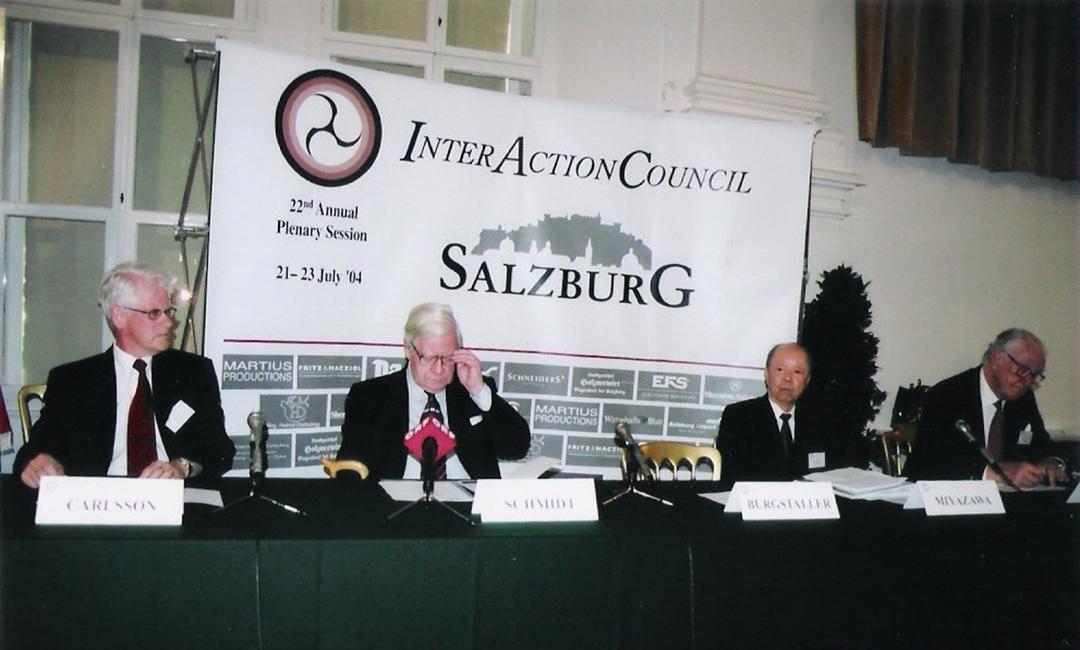
Final Communiqué
21-23 July 2004
Salzburg, Austria
The InterAction Council returned in 2004 to Austria, its
birth place, for its 22nd Annual Plenary Meeting to help
restore moral centrality to world affairs. In this
context, the Council considered the state of the world and
examined two critical issues: the plight of the world's
children and the justifications for military
intervention.
Present State of the World
1. A depressing return of destructive phantoms from the
20th century characterises today's world. Aggressive
nationalism, religious fanaticism, xenophobia and racism,
the glorification of war, and militarism are now all
sweeping across the globe. These phantoms have been
re-ignited and exploited by both populist politicians and
deadly terrorists while being nourished by national
humiliation and economic desperation.
2. At the same time, there have been signs of hope. The
European Union made great progress this year when 25
states joined together in a peaceful union for the first
time in their long history. In Latin America, although
democracy and human rights remain under pressure in some
countries, democracy flourishes, and there is not a single
remaining military dictatorship in South America. In Asia,
the remarkable speed of economic growth in China and India
raises hopes for the future. The recent elections in India
also testify to the strength and stability of the largest
democracy in South Asia. In China, there are signs of a
more open public dialogue.
3. Despite these positive developments, the world remains
divided into the very few rich and the very many poor. The
awful effects are most obvious in African countries. The
widening economic gap afflicts rich countries as well. The
Council once again calls on major states to open their
markets to the agricultural products of the developing
world. The WTO's Doha Round of negotiations is of critical
importance and should be concluded urgently.
4. Unfortunately, trade and poverty alleviation are
currently not the most pressing global concerns. The
American-led war on terrorism has spread worldwide and has
caused many of our leaders to forget that the use of
military force must be exercised in proportion to the
threat. The likely consequences of using excessive force
must always be considered with the utmost care. In the
case of Iraq, the manner in which the world was led to
war, the disproportionate use of force, the legality of
the action, and episodic human rights violations may
result in unintended consequence that are contrary to the
stated aims of the war on terror.
5. In the effort to isolate the terrorists and to promote
peace and progress in the Arab world, it is essential to
introduce economic, social and political reform. Progress
is hampered by both structural and cultural problems. The
oppression of women in these countries results in an
enormous squandering of human resources. The American
Greater Middle East Initiative is interesting, but under
present circumstance, the United States and its allies in
Europe currently lack the necessary credibility in the
region to champion successfully the cause of reform.
6. The Iraq War has given terrorists the opportunity to
attract new supporters. Guantanamo Bay and other
documented cases of power improperly used have compromised
the solidarity and compassion bestowed on the United
States following the attacks of 11 September. Particularly
in the Arab world, and in other Islamic countries, the war
on terrorism is perceived by many as an attack upon Islam;
terrorists consistently have taken advantage of this
misperception. This misperception adversely affects not
only the United States but also the values that the US and
many other countries seek to communicate: democracy,
freedom and respect for human rights. The Iraq war was a
disaster as it not only violated international law but was
also a very unwise political move.
7. Democracy, freedom and respect for human rights are
values at the core of the American democratic system. The
strength of the American system was demonstrated when the
Supreme Court of the United States ruled that the
suspected terrorists held at Guantanamo Bay had the right
to challenge their detention in a court of law.
Traditionally, the United States has not been afraid to
acknowledge its mistakes and it has also demonstrated a
willingness to correct its errors.
8. Rule of law is essential to the successful combat of
international terrorism. Terrorism must be opposed first
through judicial means and, if necessary, through military
means. It should be the principal aim of governments and
of international institutions to isolate and to
marginalise terrorist groups through any means possible.
The terrorists themselves are probably beyond the reach of
dialogue or even deterrence, but it is extremely important
that the countries who respect the rule of law and human
rights do not enhance nor encourage terrorists through
their own conduct. Whatever can be done must be done to
bring an end to the violence in Iraq and Afghanistan and
moves towards peace must be encouraged. International
terrorists otherwise will continue to exploit the
conditions in these countries in order to recruit new
members, to enhance their own reputations, and to justify
their own violence.
9. Supporting the International Court of Justice (ICJ) is
a very important first step for nations seeking to ensure
a rules-based world. In early July, at the request of the
UN General Assembly, the Court offered an Advisory Opinion
on the legal consequences of the construction of a wall by
Israel in the occupied Palestinian territory (West Bank).
The Court concluded that the construction of this wall is
contrary to international law and that Israel is under an
obligation to cease construction and to dismantle the
constructed works. The Council believes that the UN and
the International Court of Justice should be strengthened.
The Council urges all states, and notably the state of
Israel, to abide by the judgment rendered by the ICJ and
the General Assembly. We call on the United States,
working through the quartet, to use its unquestionable
influence among Israelis and Palestinians to bring a just
and lasting peace to the region.
10. In addition to creating a rules-based world, the
United Nations plays a central role preventing the
proliferation of nuclear weapons. Next year, the UN will
host a conference on nuclear non-proliferation in New
York. Active nuclear weapons have been reduced from over
50,000 warheads during the Cold War to around 20,000
today, but the five countries that previously made up a
one-time exclusive nuclear circle have now been joined by
Israel, India, Pakistan and possibly North Korea, and
others that are developing nuclear weapons. From the very
beginning, Article 6 of the Treaty on the
Non-proliferation of Nuclear Weapons (NPT) committed the
original states to move toward total nuclear disarmament.
It is imperative that the major powers accept that nuclear
weapons are a major danger to the security of the world.
Non-proliferation will not be achieved unless nuclear
states fulfil their obligation under the NPT and unless
all non-nuclear states abandon any programs to acquire
them.
11. The North Korea nuclear issue is not only a serious
global security problem but a cause for gravest concern
within the region. This issue should be resolved through a
peaceful process of talks involving the United States,
China, South Korea, Russia, Japan and North Korea.
12 Although nuclear weapons threaten all of mankind, it
must be remembered that many millions more have been
killed by small arms. Recently, the UN Secretary General
has worked with states to create a treaty to limit and to
regulate the export of small arms and lethal weapons. The
Council, endorsing the UN effort, calls on states to renew
cooperation with the Secretary General on this pressing
matter.
13. Frequently, it is the citizens of the developing world
who suffer most as a consequence of small arms. At
present, there is no better example of this than the
exploding humanitarian crisis in Darfur in the Sudan. We
recognize that significant powers and resources are
currently committed in Iraq and Afghanistan and that this
creates a serious impediment to any new intervention. In
the strongest possible terms, the Council urges the UN
Secretary General to explore with member states the
possibility of raising an intervention force to save the
people of Darfur from massive abuse and uncontrolled
violence.
14. But, at the same time, a story of a failing
intervention is unfolding. Intervention in Afghanistan was
originally a testament to the strength of the
international system. A UN Security Council resolution
authorized the intervention, it was coordinated
multilaterally by NATO, and several member states and
large NGOs all chose to place personnel on the ground in
their effort to put an end to one of the world's most
brutal regimes. However, only 8,000 troops remain to
enforce the peace (when 80,000 are required), leaving
security in Afghanistan available only to the fortunate
few who live in the immediate environs of Kabul. In
addition, the return of the Taliban is a real possibility.
This demonstrates that when nations intervene, they have
the obligation to carry through and rebuild both the civil
and political infrastructure. This commitment should be a
significant test to prove whether or not an intervention
was just and should guide the Security Council when it is
considering authorising the use of force.
15. Recognition of the centrality and authority of the
Security Council by member states is essential to its
continued success. The United Nations would be further
strengthened if both the Security Council and the Charter
reflected the reality of the 21st Century. It surely ought
to be possible, especially after fifty-nine years since
the end of World War II and with the total agreement of
the UN, to remove the enemy clauses, Article 53(2) and
Article 107, from the UN Charter.
16. As we consider global issues such as trade, poverty,
nuclear proliferation, terrorism, and rule of law, it is
important that we do not forget that we are all
responsible for our environment. Carbon dioxide emissions,
the greenhouse effect, climate change and other warning
signals justify drastic action to protect future life. If
the developing countries begin to pollute per capita at
rich country levels, mankind would face a global
catastrophe. The rich countries must play their part and
reduce their emissions. It is essential to acknowledge the
gravity of the situation and act accordingly. As a first
step, the Kyoto Protocol must be signed and observed by
all countries.
17. The Council fully endorses the seven-point policy
recommendations proposed by the Rt. Hon Ingvar Carlsson in
his keynote speech, 'A Global Tour d'Horizon,' analysing
recent international developments during the Opening
Session on 21 July 2004.
Are We Meeting Our Responsibility to Children?
18. The Council strongly endorses the eight
recommendations made in the Report of Chairman, The Rt.
Hon. Malcolm Fraser, during the High-Level Expert Group
Meeting 'Are We Meeting Our Responsibility to Our
Children?' held in Tokyo, March 19 -20, 2004. The Council
further recommends the following:
19. The Council noted with considerable interest the
British proposal for developing an International Finance
Facility (IFF) and its possibilities should be explored as
a matter of urgency. The IFF is intended to avoid the
immediate constraints many governments face when trying to
increase aid expenditures. The IFF should be supported in
its effort to put into effect the immunization plan
developed jointly by UNICEF, WHO and The Vaccine Fund. The
development of this facility does not absolve states of
their responsibility to reverse the disturbing downward
trend in aid levels. The United Nations should continue to
enjoy financial and other forms of support from its
members.
20. Debt burden is one of the largest single inhibitors
for countries trying to make a fresh start. The Council
proposes a move towards a system that replaces development
loans with development grants. Tying development monies to
a reduction in arms and military capabilities and good
governance should strengthen the development process.
Wealthy nations providing development aid and the
international financial institutions should analyse and
take account of the level of military expenditures of the
recipient countries. Financial assistance should be
reduced if (as is true in many developing countries) the
military expenditures are excessive in relation to defence
requirements.
21. We should remember that children are under threat in
the developed world as well as the developing world, and
in this regard, the Council takes particular note of
indigenous children. It is imperative that a commitment to
children become a key part of the personal ethics of the
world's leaders.
22. A commitment to ensuring that every child has adequate
primary and secondary education is among the most
important priorities for the world's children. Teaching
our children global values and tolerance would also make a
major contribution to their development.
23. To acknowledge an ethical responsibility to children
is about being committed to more than one's own or one's
nation's interest. It is a commitment to the most
vulnerable human beings. It is the essence of the global
ethics that has motivated the InterAction Council and its
founder Takeo Fukuda.
Justifiable Cases of Military Intervention
24. The Council strongly endorses the recommendations
made, except item 5, in the Report of Chairman, The Rt.
Hon. Malcolm Fraser, on the High-Level Expert Group
Meeting 'Justifiable Cases of Military Intervention', held
at the Bruno Kreisky Forum for International Dialogue in
Vienna, July 17-19, 2004. The Council further recommends
the following:
25. We reaffirm the centrality of the UN Security Council
and the importance of all states working with and through
the Council in matters of international peace and
security.
26. The principles of the Just War Tradition should guide
the Security Council as it considers military
intervention. Those principles are: the justness of the
cause, the presence of honest intentions, just authority,
the proportionality of the response, the necessity of the
intervention and compliance with international
humanitarian law.
27. The intense debate over the Iraq war demonstrates
again the need for high moral standards in the conduct of
international relations. The Council, therefore, once more
calls for the leaders of the world to promote the highest
standards of global ethics and to bring forward to the
United Nations the Universal Declaration of Human
Responsibilities.
At present, the world community faces its most critical
period since the end of Cold War. Recent policies and
events have pushed the world closer to a clash of
civilizations. But we remain confident that these dangers
can be met provided that states work together and support
the United Nations. What must guide all of us at this time
is a truly global ethical standard.