

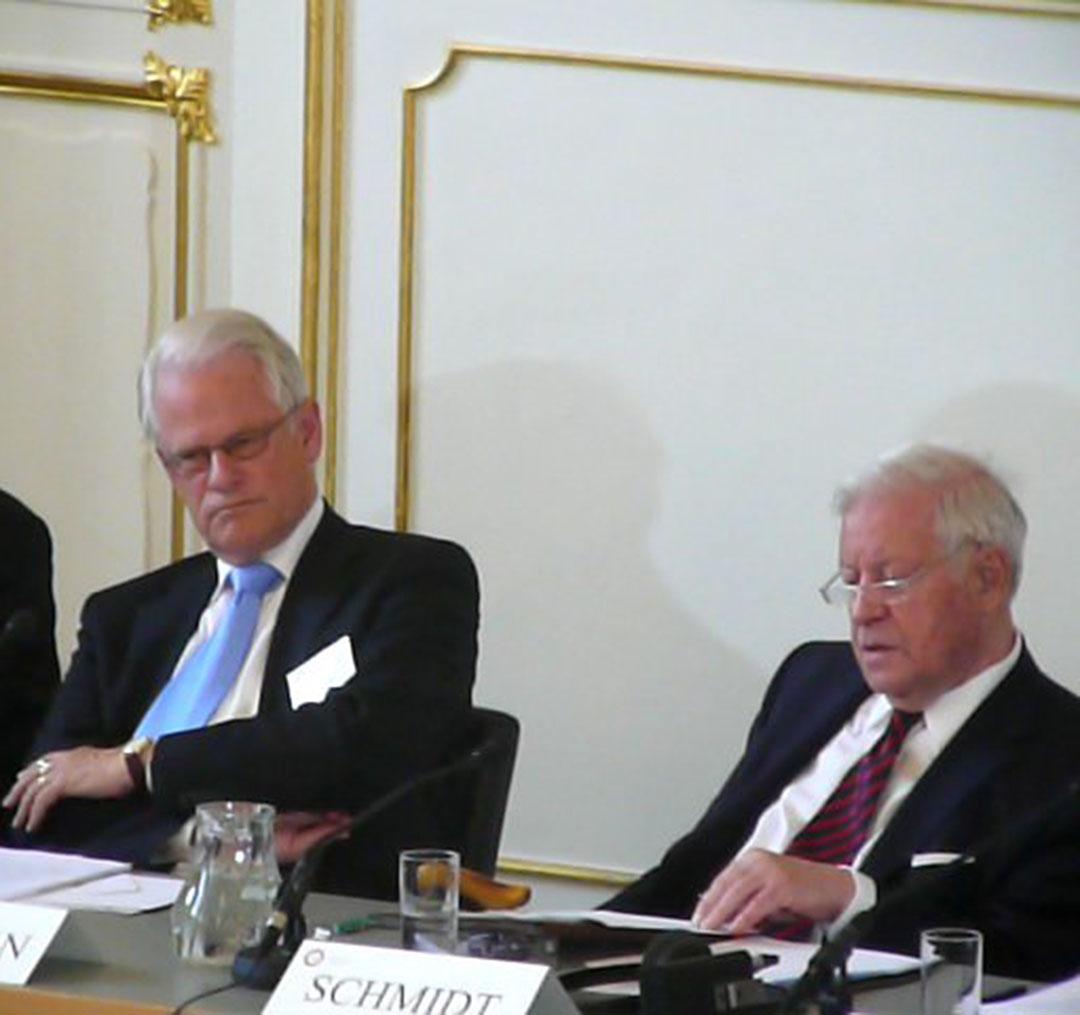
Keynote Speech at the Opening Ceremony
25th Annual Plenary Meeting
21 May 2007
Hofburg Congress Center
Vienna Austria
By Helmut Schmidt, Honorary Chairman
Download the PDF
It has taken our Chairman Ingvar Carlsson and his right
hand Mrs. Keiko Atsumi a joint effort to impose on me the
task of trying to offer you a tour d’horizon on the
present state of the world. The first consequence of their
violent act was that Tom Axworthy and I had to undertake
the strenuous task to put our observations into a draft
manuscript. But then the second consequence is that you,
ladies and gentlemen, will have to endure a rather lengthy
speech.
It was a quarter of a century ago that our Council has
held its first meeting in Vienna. Our deceased Japanese
friend Fukuda Takeo had in 1982 conceived the idea of the
InterAction Council in order “to make contributions to
threatening problems”. He has once described the 20th
century as “the century of glory and of remorse”. Glory,
because of the tremendous progress in science, technology,
health and economic growth. Remorse, because it had been
the bloodiest century in history and because of the tragic
abuses of the Holocaust and genocides and ethnic
cleansing, of enormous war crimes and human rights
abuses.
In the meantime, the world has changed considerably.
Although we are still not living in a peaceful world, at
least there is no prospect of a third world war. The
present world does differ enormously if compared with the
scenario that leaders like Mao Zedong and Khrushchev or
Brezhnev and John F. Kennedy or Ronald Reagan had before
their eyes – and if compared with the dangers and the
chances that those leaders had to deal with. But quite new
dangers and new challenges and as well new opportunities
and new chances have emerged.
I. Globalisation
Let me start with the phenomenon of globalisation. The
term “globalisation” is new but worldwide trade has
existed and played an important role since Marco Polo or
Vasco da Gama or the Hanseatic League. What really is new
is the enormous increase in quantities as well as in
speed. Whereas China and the Soviet Union had been almost
totally closed to global trade, they are nowadays fully
participating. On top of that, the volume of global
exports and imports has multiplied. This quantum-leap, in
which almost everyone of the 200 states is participating,
has been made possible by a simultaneous qualitative leap
in transportation and communication. Not only on the
oceans of the world and in the air but as well by
electronic means. What today is called high-tech was
inconceivable not so long ago. During our life-time we
have witnessed a speedy scientific and technological
progress. And electronic communication – f.i. by way of
the internet – enables anybody, if he or she has the
necessary professional education, to use and fructify
scientific and technological achievements, that have been
developed in a country thousands of miles away from his
own, developed by people whose language he or she does not
understand.
Several thousand years ago, it did take mankind several
centuries to learn how to make a cup from clay. Thereafter
it took again centuries to make vessels from bronze; then
came iron, but it did take many centuries to go from iron
to steel. During the 20th century it did take less than 50
years from the first aeroplane flying in the air to drop
bombs from big aircraft and destroy a whole city within
just a couple of minutes. We are witness to a breathtaking
acceleration of technological progress.
We have to expect a continuation of this very quick
progress of science and technology. We as well have to
expect a continuation of the rather quick globalisation of
any scientific or technological innovation. Whether we
think of the method of transplanting the heart of a dead
human into some other human’s body, living thereafter with
a foreigner's heart, or think of new gene-technological
discoveries and achievements or whether we take new
techniques in automobiles, in rockets and military
weapons: All the new techniques – be they developed in
Tokyo, in Bangalore, in Stanford, California, in Beijing
or in Eindhoven, Netherlands – will be available all over
the globe. In the fields of science and technology we will
be living in one big community, so to speak: we are in
fact going to live inside a global village. All this is to
happen despite the fact that most Americans will not
understand Chinese, that the average Russian will not
understand English. And despite the fact that the great
majority of mankind will still identify themselves by way
of their language, their family, their religion, their
tribe or people or nation.
There is no use in protesting against the globalisation of
technology, because it will inevitably go on! And the same
goes for the globalisation of trade in goods and services.
Take my own country, Germany, as an example: We are just
80 million people, but we are intertwined with the economy
of nearly all the 200 states; we do export about 40 % of
our Gross National Product, we at the same time do import
almost 40 % of our GNP. If a German government would try
to decrease this high degree of globalisation of our
economy, the result would inevitably be a considerable
decrease of employment and of our standards of living.
Already since the 1970’s there is no longer a possibility
to decouple the German business cycle from the ups and
downs of the global economy as a whole. I have understood
this fact of life at first by way of the two global
oil-price explosions during the 1970s.
By the way, the same is true of many other sovereign
states today, they can influence the structures of their
societies and their economies, but no longer are they
capable to steer the business cycle with national
means.
Another example is today’s China. If by a political
disaster China’s exports would no longer be bought by
customers in America, in Europe, in Japan and in the ASEAN
countries, it would inevitably create economic disaster in
China. Or take the USA as a third example. If for some
political reason the confidence of the world in the
vitality or the American economy would vanish and if
therefore the enormous net inflow of foreign capital and
savings into the U.S. would stop – by the way a net
capital import in the order of 7 % of the annual American
GNP! – it would send the US into deep recession and
possibly into depression.
The lesson from these three examples is this: there is no
realistic chance to renationalise our economies, we cannot
in reality impede the ongoing globalisation of our
economies. We cannot prevent globalisation – therefore we
have to prepare for the consequences! And we have to
jointly try to manage the global process!
Already during the first oil-price-shock Valéry Giscard
d’Estaing and I persuaded the leaders of the major
economies of the 1970s to coordinate our monetary and
fiscal policies, in order to prevent a global wave of
monetary inflation and its unforeseeable economic and
political consequences. We did meet in the autumn of 1975
at Rambouillet, France, in a large private living room,
far away of the press and of television. In those years
the G-7 did account for one half of the world's economic
activity. And we have been moderately successful in
managing the macro-economic global imbalances.
It is thinkable that within decades the GNP of Brazil,
Russia, India and China – the four so-called
BRIC-countries – combined will be greater than the old G-7
countries combined. It is no longer thinkable that the
present G-8 can succeed in macro-economic co-ordination in
order to manage the world’s economy. It appears to be a
delusion to be able to successfully manage the globalised
economy by a G-7 or nowadays G-8 economic summit in
the absence of China, India and Brazil.
In my personal evaluation, a joint effort to keep the
world’s economy on an even keel needs a regular
co-ordination between the old seven, nowadays eight old
industrial powers but one has to include as well China,
India, Brazil – plus at least one of the major oil
exporting countries, for instance Saudi-Arabia, plus at
least one of the larger presently not industrialised
developing countries in Africa, for instance Nigeria or
South Africa or Egypt. I would as well think of the
European Union, Indonesia and Mexico.
The United Nations is a universal institution and its role
will remain to be valuable. But one cannot galvanise 200
leaders, and enlarging the Security Council seems to be at
a dead-end. The value of a G-15 is that it is small enough
to have real discussions, representative enough to include
the major powers of our new multilateral world, and
flexible enough to have serious negotiations on everything
from the Doha Round to pandemics, climate change, or
sensible strategies to combat terrorism. It would be even
better if a new G-15 gave up the practice of concocting
communiqués months in advance, and would meet the media
only if they had something to say.
At present the whole world does enjoy an economic boom,
which is having positive effects on almost every country
in all the five continents. It does provide good
opportunities for many countries and for the world to
undertake those reforms and innovations which had been
neglected since decades. This boom will certainly not last
for ever, therefore it is imperative to use the present
opportunity!
It is not unthinkable that it may take just a short while
until all of us will be confronted with a major economic
crisis. I have to mention here the possibility of another
currency and exchange-rate-crisis. The enormous surpluses
in the Chinese and the Japanese trade balances plus the
enormous American deficits bode no good for the stability
of the constellation between major currencies; and this
situation is a standing invitation for thousands of
speculators in the financial centres.
And even if the present monetary and currency imbalances
do remain manageable, the globalised financial markets
themselves by all their inscrutable new financial
instruments – hedge-funds and derivatives of thousand
different nature, private equity corporations or
unfriendly take-over-specialists and predatory capitalists
– could create havoc by their intrinsic tendency to behave
and act as a herd of sheep or geese. Just like the global
sea and air traffic are subject to strict security and
traffic rules, as well do global capital movements need
regulation to avoid catastrophes. This would be an act of
preventive rationality – to say nothing of decency and
ethics. Since the International Monetary Fund has lost its
essential task already three decades ago, the future
G-15might entrust the IMF with the new task to develop a
trans-national system of supervision and control of
financial markets and its participants.
II. On Global Challenges
1. Besides of the global challenges which stem from recent
developments of the global economy, there does still exist
a number of dangers, actual ones and thinkable ones that
we have known since long. First of all the explosion of
the global population will go on for the foreseeable
future, let us say at least for the first half of the 21st
century. Within about 40 years or so we will be 9 billion
human beings, which is about five times as many as in the
beginning of the last century, when my own father still
attended his primary school. Because the space on the
surface of our globe will not enlarge, the available space
per capita will shrink further. This will in the main
happen in Asia, in Africa and as well in Latin-America. In
those continents the tendencies for migration, for local
wars, for uprisings and civil wars will probably continue.
Ever greater masses will live in huge cities and not any
longer in villages. The problems of providing employment
and food for these masses will certainly persist. As well
the dangers of epidemics and pandemics will persist.
All this will particularly happen in those developing
countries and states which do own their existence and
their borders not to common language and religion and
extraction but to the arbitrary decisions of their former
colonial masters and which therefore are extremely
difficult to govern and which for the same reason have as
yet only marginally been benefited by the economic
globalisation. In this context I have to mention the
present Doha Round of trade negotiations. I regard it to
be a grave mistake and morally a shame that the old
industrialised countries, particularly the US and the
European Union, still deny the developing countries to
export their agricultural products. If the people are not
permitted to export their products they will export
themselves!
So far only the People’s Republic of China has rigorously
tried to dampen the further growth of their population. It
was of course a problematic undertaking, but Western
criticisms have no legitimisation. Even if mankind as a
whole will be able to cope successfully with the
consequences of the population explosion – and this is a
very big if! – nevertheless I would not be astonished to
see other densely populated developing countries emulating
China’s effort.
2. Apart from the explosion of the global population,
going on since World War II, the climatic change does
appear to only recently have caught the public’s eyes and
ears. The fact is that the climate on the surface of this
globe has varied since millions of years. We know of
several ice ages and warm ages. For instance one does find
the teeth of Mammoth-elephants in Germany which proves
that once upon a time the climate in Central Europe
was warm enough to sustain elephants. And in my garden in
Hamburg, we do find mussel-shells in our soil as a proof
that once upon a time during a warm age our garden has
been part of the Atlantic Ocean. I mention these facts in
order to warn against climatic hysteria as if the end of
our world was just around the corner. Also to warn against
the other hysteria as if we were capable to prevent
climatic changes. What we ought to do is to prepare for
it.
Having said this, I must stress the fact that indeed
mankind is presently contributing to global warming. And
it is a fact that we can decrease our several
contributions. I have publicly urged governments to take
action since a quarter of a century. So far the
international agreements to curb the emission of
greenhouse gases do not cover China and India, and the US
have cancelled their participation. These three giants are
critical to the solution of the problem, and the Kyoto
Protocol therefore is quite insufficient. I consider this
problem to be a major task of the heads of state or of
government who ought to tackle it in the future G-15.
3. A third global challenge appears also to be relatively
new. The catchword “Clash of Civilisations” was coined
just a dozen years ago, but nowadays a clash especially
between Islam and the Western civilisations has become a
real possibility – a possibility, by no means a
probability. It still can be avoided.
In some quarters of the Islamic parts of the world, we
meet a mixture of disgust and revolt against poverty plus
envy about the luxury of Western nations plus religious
terror plus the quest for political power. The terrorist
crime against the twin towers of the World Trade Centre in
New York five years ago was a symptom of religiously
inspired hatred. The superfluous war against Iraq has
multiplied the number of Islamic terrorists. Western
countries have used military power not only against Iraq
and inside Afghanistan, but as well in Bosnia and Kosovo,
all these countries being inhabited by Muslim majorities,
and the US are assisting Israel against its Muslim
neighbours. It is not too difficult for zealots to derive
from this fact a general enmity against America or against
the West as a whole.
It seems advisable for the West – and I would expressly
include the Vatican – to very carefully avoid any looking
down with condescension on Islam. The world religion of
Islam is entitled to the same respect and tolerance as is
the Christian religion or Buddhism, Hinduism, Shintoism or
the Jewish religion. Political leaders must never misuse
their religion for political purposes. Religious leaders
must never let their religion be misused for political
purposes; they must never use politicians to spread
religion.
It is of course much easier for a Western to say this than
for many Muslims to accept it. Because the concept of the
secular state has been developed in the West. It was only
stepwise developed since the beginning of the era of
enlightenment; earlier on also the Western states were
characterised by their official and also actual confession
of the Christian religion, the struggle for supremacy by
the popes versus the kings and emperors not withstanding.
Within the great number of states with Islamic inhabitants
or Islamic majorities, quite a few states have not as yet
completed the separation between the political and the
religious authority; Iran is one example, the fight about
the maintenance of the secular state inside Turkey is
another illustrative example. The West will have to accept
the non-secular Islamic states as a fact of life.
But neither political nor religious leaders have any
legitimating to impose their political ideology or their
religious creed on to peoples outside their own
jurisdiction. And the same goes of course for the media.
This Council has preached this appeal for tolerance since
our meeting in 1987 with leaders of all the major
religions, we will again this time in Vienna devote our
deliberations to the same appeal. It is more urgent today
than it was twenty years ago.
4. Having mentioned ongoing military interventions I would
like to add a short paragraph on the subject of the
so-called “humanitarian” interventions. Since the end of
the Cold War between the West and the Soviet dominated
East, we do observe a growing number of peacekeeping
interventions into sovereign states. Some of these
missions have been legitimated by decisions of the
Security Council, but a few have been
undertaken without the Security Council's consent,
thereby violating the Charter of the United Nations. The
military intervention in the failing state Yugoslavia, the
occupation of Kosovo and Bosnia and the bombs on Belgrade
served as an outstanding example. In many cases one finds
it difficult or even impossible to bring the intervention
to an end and withdraw one’s troops from foreign soil. In
quite a few cases it is obvious, at least from hindsight,
that the intervention was and still is in the main serving
the political interests of the intervening powers rather
than the interest of humanity.
I wonder whether our Council might find it appropriate to
issue a word of warning to present members of the United
Nations not to let one basic principle of peace be totally
neglected. I for one am under the impression that the
basic principle of non-interference is almost totally
forgotten.
III. Different Situations in Different
Continents
Let me leave the chapter on global challenges at this
point and draw our attention towards the different
situations on the different continents.
1. I have long believed that China would again enjoy the
status it had for three millennia as a pre-eminent world
power. It has achieved that status again. And India is not
far behind. China has more than a trillion dollars in hard
currency reserves, after having grown economically at 8-10
% annually for decades. India has one of the world’s most
sophisticated high-tech sectors, and Indian industrialists
are now buying companies around the globe. China and India
are both nuclear powers, and each has more than a billion
people. Within two additional decades China and India will
have the world’s second and fourth largest economies,
respectively.
Despite the unsolved Kashmir-problem, the Taiwan-problem
and North Korea’s nuclear ambitions, there does not loom
any international conflict on the horizons of East and
South Asia. Both India and China are very cautious and
responsible in the arena of international and global
affairs. Both giants do not appear as militarily
threatening their much smaller neighbours. China has
played a constructive role in trying to restrain North
Korea, and the eventual solution to North Korea’s
threatening armament will certainly require China's
influences.
I often think of our long time friend Pierre Trudeau who
had personal and deep knowledge of China. I think he would
welcome this huge change of China regaining its vitality.
He favoured what he called counterweights or what I call
balance in world politics. The emerging multi-power world,
rather than a unipolar world is what he would have
favoured. How the rest of the world, especially the United
States, responds to this change will determine whether our
future is characterised by stability or by chaos. There
should be no doubt that the solution of any of the great
challenges facing the globe will have to include the Asian
giants. If we want to progress, we must adjust to this
fact.
Of course, both the Asian giants are faced with severe
problems inside their border, India in particular
regarding its enormous growth of population. Mistakes and
failures cannot be excluded. But in their foreign
relations both do appear to me as peaceful and
reliable.
2. The same cannot be said about that part of Asia, which
we call the Middle East. If I use this term Middle East, I
am including Central Asia, Iran and Egypt as well,
although Egypt is part of the African continent. In this
sense the Middle East composes a great part of the more
than one billion Muslim believers – and as well Israel. It
as well does comprise that part of the world in which the
greatest number of political conflicts is concentrated.
And as well does it comprise the great bulk of the oil
reserves of the world, which is of vital interest for all
the other countries.
Inside this vast region most of the presently existing
states do owe their borders and their statehood to
decisions by the former colonial powers, either after
World War I, or after World War II. Only Iran and Egypt
are based on millennia of history. Both of them have
determined the destiny of the Middle East since biblical
ages. Islam and the Ottoman Turks came much later. In
Iran, formerly called Persia, we find since three decades
a religiously governed state with considerable domestic
tensions, whereas Turkey since the 1920s has turned into a
secular state but with considerable domestic tensions as
well. With the exception of Israel all states in the
region are governed in a more or less authoritarian and
dictatorial manner. A few of the religious and the
political leaders are belligerent.
The Iranian President gives particularly belligerent
public speeches. Iran, on the other hand, is a signatory
to the Non-Proliferation-Treaty regarding atomic weapons;
they have not as yet cancelled their obligations under
that treaty what would legally be possible as the
North-Korean example has shown. It appears unclear whether
Iran really strives for nuclear armament; all American
accusations so far remain unproven. So far Israel is the
only nuclear weapons state in the region. Any military
intervention against Iran would be a violation of the
United Nations charter; it would probably drive the whole
region into chaos.
Iraq is a typical case regarding the consequences of a
frivolous military intervention. It is easy to enter but
very difficult to leave the defeated country alone. Iraq
could fall into three different parts: Shiites largely in
the south, Kurds in the North and Sunni largely in the
middle. If these three parts break away it might
destabilise the whole region, because neither Iran nor
Turkey would accept an independent Kurdish state at their
borders, due to the fact that both of them do have large
Kurdish minorities inside their own borders. I hate to add
that also in the case of the intervention in Afghanistan,
legitimated by the UN, it will foreseeable enough be again
extremely difficult to leave the country.
Israel does owe its moral legitimisation to the murderous
holocaust. Almost all the Arab leaders have by now
accepted the existence of Israel as a fact and are willing
to offer full recognition. The only long-term solution of
the perennial bloody Israeli-Palestinian conflict is in a
two-state peace settlement based on the 1967 borders. It
has taken the Arabs a long time to come to this insight.
The Israelis so far have relied only on their superior
military capability and on the assistance of the USA. They
do not as yet appear to follow a viable long-term grand
strategy.
Without peace between Israel and its Arab neighbours the
Middle East will remain an unruly region, endangering the
peace of nations and states outside. Peace does require to
sit down and talk, listen, answer questions – and it does
require the will for compromise. My Egyptian friend Anwar
al Sadat has – with great courage – set the first example,
Itzhak Rabin was following; both statesmen have been
murdered by extremists of their own nation. Since Camp
David 1978 America has taken a great deal of the
responsibility for peace between the Arabs and Israel.
America has good relations with Israel, with Saudi-Arabia,
Egypt and Turkey. Washington is in a unique position to
mediate. The recent Saudi initiative and the Arab League
summit in Riyadh does offer an opportunity. But then:
Mediation takes both judgment and courage. I must
confess not to be overly optimistic. Maybe we have to
wait for the next president in Washington D.C.
As a footnote I would like to point to a thinkable
strategic contribution by Israel. Israel has the only
modern economy and technology in the region. If Jean
Monnet were advising Israel today, he might say: Use your
technological and economic capabilities to invite your
neighbours to join you in cooperative projects in water,
trade, joint tourism, etc. The “soft power” of Israel may
in the long run be far more useful than the hard power of
its military.
3. Let me switch to Africa. Also in this continent most of
the present states and their borders have been determined
by the former colonial powers – with no regard to tribal
realities, to languages, to religions and to geography.
The artificiality of the states does make government and
administration extremely difficult, more difficult than in
all the other continents. The European powers have
colonised almost all of Africa and exploited it for their
own needs. When after World War II they could no longer
maintain their rule, some of the new sovereign African
states were used as proxies for the conflict between the
West and the Soviet Union and one strong man after the
other was propped up without giving attention to their
looting their own peoples.
Today these horrors have passed and many Africans are
taking responsibility for their own future. Yet, we must
not replace the exploitation of the past with indifference
now. Africa is still the home of terrible conflicts: The
Great Lakes region, also countries to the East and North
of the Democratic Republic of Congo, have been violated by
conflict since the Rwandan genocide in 1994. These wars
resulted in more than five million casualties. Darfur
and the Horn of Africa are equally tragic. In my view the
Organisation of African Unity must play the major role,
because we know from our experience that humanitarian
interventions from the outside world can cause as many
problems as they try to solve. We ought to remember the
oath of Hippocrates – “above all do no harm.”
Africa still suffers too from the old blights of disease
and poverty. The AIDS epidemic in Africa has killed 13
million people. Sometimes we doubt the efficiency of
development grants – I would prefer to get Africa much
better access to Western markets – but there can be no
argument about the need for concerted world action on the
public health priorities of AIDS, malaria, TB, and
diarrhea diseases. The West once sent slave ships to
Africa; now we must send medicines. In Japan, a girl who
is born today has a life expectancy of 86 years, but in
Zimbabwe a girl can only expect to live to be 34.
Africa as a whole is a neglected continent. All together
the African picture is relatively bleak. But there are
also signs of improvement. In 1983 this Council “deplored
the despicable system of apartheid”. Thanks to Nelson
Mandela, who showed generosity and forgiveness worthy of
Gandhi, South Africa has made a remarkable transition.
4. There are a few similarities if we compare Africa and
Latin America. Both continents do consist of developing
countries, we find mass poverty and political tensions in
both places. Both continents do not endanger the peace of
the outside world. But otherwise Latin America is clearly
better off. One of the reasons is the fact that we have
hardly ever seen an armed conflict between South-American
states. Another reason is the fact that most of the states
have been established already a long time ago and,
therefore, had a much longer period of time to develop
education, also to introduce modern technologies,
medicine, economic behaviour and administrative
capabilities. It may very well be that the project
Mercosur, a common South American market, will succeed;
they will anyway be able to use the foregoing example of
the European Common Market and its experience. It is of
course very helpful that there is hardly any racial
strife, just two languages and only one great religion.
Latin-America is a Roman-Catholic continent, in which many
people nevertheless do not obey all of the rules, which
are preached by the Vatican. The bishops in Brazil or in
Mexico are much more tolerant than the Vatican.
Nevertheless the birth rates are high and alike in Africa
and Asia; also Latin-America is contributing to the global
growth of population.
5. By contrast Europe is the only continent with a
shrinking population. The charts of birth rates may give
the impression of a decline of vitality, but it is unclear
whether the present trend will last. For the time being
this trend and the unforeseen aging of the societies must
not give us headaches. On the other hand, Europe for the
first time in centuries is enjoying real peace among its
nations and states. After a millennium of bloody wars,
Europe is at peace with itself and has released its former
colonial empires.
The European integration, started in 1950 between just six
countries, has developed into a union of 27 countries and
one half of them do share one and the same currency. The
EU of course had to overcome several crises; right now we
try to overcome a so-called constitutional crisis. And it
may well take another fifty years until we may arrive at a
common foreign policy, if at all. Nevertheless the
evolution is highly likely to continue.
The responses to the EU by Russia and by the United States
may constitute a critical factor for the future; but it
appears very improbable that any dangers to global peace
will ever again emerge from Europe.
IV. The World Powers
Since the implosion of the Soviet Empire, a few people,
mostly Americans, do believe the US to be the one and only
world power. Some even believe that the only superpower
does have the mission and the capability to guarantee
stability and peace all over the globe. For the sober
mind, it is obvious that a fleet of big aircraft carriers,
nuclear-equipped long range rockets plus some troops do by
no means suffice to politically stabilise the globe.
1. Today as well economic and financial power alone can
make a great country into a world power. Take China as the
presently outstanding example. Thanks to the economic
instincts of Deng Xiaoping, it will rather soon replace
Germany as the world's export champion. The growing
Chinese demand for oil and gas and raw materials of all
kind has a heavy influence on prices on the world markets.
On top of it, China can dispose of an unprecedented huge
amount of currency reserves that could easily be used for
geostrategic purposes. Even if the Chinese military
capabilities do appear relatively limited in scope, one
has to understand China’s world power status. The US,
Russia, Japan and the world at large ought to accept that
as a fact of life and to handle their relations with this
upcoming world power with careful diligence.
The same will soon apply to India. Both these Asian giants
are to be considered world powers – due to their sheer
size, due to the efficiency of their large economies and
not least due to the political influence that they can
exert not only in all of Asia but as well all over the
world.
2. Russia, even after the end of the Soviet empire, still
is and will remain to be a world power, not only because
of its military might, but as well because of its huge
territory, which is full of hitherto unearthed mineral
resources. At present and for the foreseeable future,
Russia enjoys the enormously growing global demand for
natural gas and petrol and also nuclear energy capacities.
The gas- and petrol-factor is strengthening
the international role of Russia, although it does
not as yet equal the great impact by which OPEC three
decades ago was capable to throw the whole world into
recession.
Russia’s worldwide military power has been very great
during the Soviet era and during the Cold War. Since then
it has decreased – both in absolute and in relative terms.
Many Russians and probably also Vladimir Putin would have
liked to maintain the former Soviet Unions military power
and its international importance, but the Soviet Union was
almost double the size of present Russia’s population and
nevertheless the Soviet military expenditure largely
over-exhausted the empire. I do not observe any
indication, that this mistake will be repeated. After the
Soviet attack against Afghanistan, twenty-seven years ago
(which was a blunder by a senile regime) neither Gorbachev
nor Yeltsin nor Putin have transgressed into foreign
territories. But quite a few Americans do maintain their
former mistrust, suspicion and enmity. The US and as well
NATO have lost a formidable enemy but to quite a degree
they stick to their old attitudes, which in turn feeds
corresponding feelings in Russia.
The Russian nation differs in many ways from the European
and the North-American nations. It is a unique entity of
its own type and own class. Since a thousand years it is
used to autocratic regimes, it will not turn to a
Westminster – or Washington – democracy. For a long time
to come, the Russians will be occupied with
the unavoidable digestion of the enormous losses due
to the demise of the Soviet Union and with the urgent
modernisation of its state, its society and economy.
The future evolution of Russia is a source of great
curiosity and interest to its neighbours and to many
nations on this globe. In my view the future of Russia is
by far less uncertain than for instance the future of the
Middle East or the future of Sub-Saharan Africa as a
whole. Personally I would always prefer a Russian world
power role based on its gas supply and its economic
strength rather than a world power role based on strategic
weapons.
3. The world power United States, due to its superior
military and economic strength carries a special burden to
act responsibly. I admire the vitality and generosity of
Americans. Never will I forget the American Quakers who
gave me my first serviceable shoes after I left my
Prisoner-of-War camp; nor will I forget the Berlin
airlift; the Marshall Plan (ERP, European Recovery
Program); the care-packages from relatives in Minnesota to
my family in Hamburg; or Leonard Bernstein’s concerts in
Germany right after the war. In assessing the current
potential of Europe and of Japan, one should never forget
that American policy played a hugely constructive role in
the rebuilding of those societies. The generous tradition
in American life is for example represented by the
life-time career of former Vice President Walter Mondale
who joins us for our 25th Anniversary.
The US has quite a number of countries joining them out of
opportunistic calculation, but more important is that the
American nation does have many friends out of inclination
and affection. After the colossal crime against the twin
towers at Manhattan six years ago, the wave of sympathy
with America all over the globe was almost overwhelming.
Today, some of the sympathy has vanished; some friends and
allies are puzzled and anxious. This deplorable change was
triggered by strategic and foreign political decisions
which the present administration in Washington has made.
The Iraq war has created new tensions and enemies.
The United States has competing traditions in its foreign
policy of isolationism, internationalism, and
unilateralism. Even under the most internationalist
administrations, America sometimes has made unilateral
decisions that have harmed the interest of others and even
of its allies.
National egoism is a fact all over the globe, the US is
not alone in this respect. But it has remained for the
present US-administration to enshrine this practice as an
official doctrine. The 2002 National Security Doctrine of
the United States has declared that America reserves to
itself the right to launch preventive and pre-emptive
wars. We saw the results of that doctrine when the United
States launched a war of choice, not of necessity, in
Iraq. The men who started that war had, by the way, never
personally fought themselves, confirming the wisdom of
Erasmus of Rotterdam: “War is sweet to those who have no
experience of it”.
By waging war on their own and without a decision of the
Security Council, the United States has thrown to the wind
the rules of international law it had itself established.
This war of choice was opposed by France, Germany, Canada,
and most people in the rest ofthe world. Seeing the
current chaos in Iraq, many Americans today regret their
administration’s rush to war under the pretext of weapons
of mass destruction that did not exist. The
simultaneous neo-conservative enthusiasm for democracy in
the Middle East reminds me of John Galsworthy’s axiom that
“idealism increases in direct proportion to one’s distance
from the problem”.
The United States has once promoted the rule of law. It
played the largest role increating the United Nations, the
World Bank, the International Monetary Fund, and the World
Trade Organisation, all rules-making institutions. Rules
are critical because no decision-maker has a monopoly on
wisdom. That is also why debate and contention are a
sounder way to truth than dictate. An open society
requires open debate. The genius of the American
Constitution is to have countervailing institutions that
check and balance each other. The necessity for balance is
even more important internationally, when the stakes are
often life and death themselves. Leaders must have a clear
picture of one’s own national interest, but also do they
need willingness to compromise and to meet the national
interest of others.
Right now, since the race for the next President and the
next Congress has started in America the outside world has
begun to contemplate the future role of the US under a
future government. So has the American nation themselves.
I find it too early to speculate. But I am still convinced
of the vitality and as well of the inner political compass
of the American people. In the early 1950s I did
experience the psychosis created by Senator Joseph
McCarthy, but I am also a witness to the strength of the
democratic instincts, of the reason and the vitality with
which the nation overcame that psychosis. I am convinced
of a comeback. But as well it seems clear to me: America
is not going to be the one and only world power.
4. By contrast the European Union is not a world power as
yet. It may take another half of a century until the EU
arrives at one common foreign and security policy, but
whether that at all happens remains to be seen. In the
meantime the outside world will have to deal with 27
ministers of foreign affairs plus a changing President of
the European Council. Of course, they will try to act in
unison but it can sometimes happen that the 27
member-states will not pursue parallel policies. Certainly
is the EU not a threat to others; all the members have
joined by their own will.
Right now the EU finds itself in a constitutional crisis.
The solution will take time. But I am not pessimistic
about Europe’s future. After all, most of the
participating nations and each national language is older
than at least 1000 years. What we have achieved so far is
an unbelievable success. Up to now it took us a bit more
than half a century – a rather short period if you compare
it to the millennium of intra-European wars that have
happened before. Whenever the present crisis is solved and
in whatsoever manner – the common market and the common
currency Euro will certainly stand up. Because no national
leader can without enormous damage to his own country take
out his own country again.
The outside world has to reckon with the permanence of the
economic European entity. The EU will remain a complicated
but unique body with no parallel in any other continent
and no parallel in the history of mankind. Nobody in the
outside world needs to be afraid of the EU.
5. My swift sketch of the world powers would be all too
superficial, if I left out their joint responsibility for
the quiet death of arms control. If one considers the
arsenal of military weapons around the globe, from
sub-machine guns and land-mines to nuclear rockets, then
the combined destructive military power in 2007 is a
thousand times greater than it ever has been during World
War II. There exist more handheld small weapons than ever
and as well more nuclear weapons states than ever – and
their number may still grow. The responsibility for this
sad fact does clearly fall onto the shoulders of the world
powers.
At the end of World War II there was just one state that
could use nuclear weapons. During the1960s we already had
five nuclear weapons states, US, Soviet Union, China,
France and Britain. In the meantime India, Pakistan,
Israel and possibly North Korea have equipped themselves
with nuclear weapons, increasing the number of nuclear
weapons states from five to eight or nine. The first five
nuclear powers at the end of the 1960s initiated the
Nuclear Non-Proliferation Treaty, NPT. This treaty is an
“asymmetrical” treaty, because it grants privileges to
those five nuclear weapons states based on the condition
that they phase out their own arsenals. The NPT tells them
to cease “the nuclear arms race at an early date”.
All five, but especially the United States and Russia,
have violated their obligation in many ways. They have
“modernised” their existing weapons systems by deploying
many new nuclear weapons and attendant delivery systems.
Late in 2002 the US have withdrawn from the 1972
Anti-Ballistic Missile Treaty, ABM, and have started to
establish an Anti-Ballistic System in America and in
Europe. A new technology-based arms race is to be
expected, focusing on anti-missile defence. It may create
an additional global challenge.
The United States says that the anti-missile shield in
Poland and Czechoslovakia is directed at Iran, not at
Russia. But from the perspective of the Russian general
staff, this development, plus the earlier extension of
NATO right up to Russia’s borders, might be interpreted as
a program to gain superiority, not ensure balance. I think
the United States should bridle itself. It should,
together with the other four initiators of the NPT, meet
its obligations under the Non-Proliferation Treaty. A new
arms race will not stabilise the peace.
responsibility of Australia or Canada, of Brazil or Japan,
of Poland or Germany! ButIt would be a major step towards
stabilisation, if the world powers were to engage in
deliberations and consequently in negotiations about a
treaty that inhibits the export of weapons, particularly
of handheld weapons, so-called small arms. Looking around
the globe, we find the majority of civilian people, who
have been killed by local wars, in civil wars and by
terrorists, small arms, imported from the outside. This is
not the these non-nuclear countries should put pressure on
the world powers in order to arrive at a world-wide system
of curbing and controlling the trans-national weapons
trade.
V. Summing up
In the end I would like to sum up.
The world of the year 2007 appears to me to be in a much
better shape than the world of 1983, when our Council
declared “The world is now threatened by the most
dangerous situation it has faced since the end of the
Second World War.” Such statement would today be
absolutely unjustified. Of course we are faced with a
number of dangers and challenges today, but our resources
necessary to meet them are largely increased. Many nations
and many leaders have learnt the lessons from the former
division of mankind into hostile camps. Today East and
West and North and South have engaged in a learning
process of cooperation.
Of course, it will take courage to change the things that
we can change. It will need serenity to accept those
things which we cannot change. And it will again need
wisdom to know the difference.